asteroids 2020: asteroids and comets similarities
Tampilkan postingan dengan label asteroids and comets similarities. Tampilkan semua postingan

Minggu, 12 April 2020

Asteroids And Comets | Science Mission Directorate Asteroids And Comets

Asteroids And Comets | Science Mission Directorate Asteroids And Comets

Asteroids and comets | Science Mission Directorate

You are here

NASA eClips Real World: Small Bodies Orbiting the Sun

NASA eClips Real World: Close Encounters with an Asteroid

Year of the Solar System Math Guide

This collection of 160 math problems covers the 20 science topic themes presented by the NASA/JPL Year of the Solar System (YOSS) website, covering the solar system, planets, the search for life, and robotics.

Astro101 Slide Set: Debris Belts around Vega

This slide set focuses on the discovery of debris belts around Vega. It is one of a series of short, topical presentations on new developments from NASA astrophysics missions, relevant to introductory astronomy topics.

Astro101 Slide Set: Binary System Makes Near Miss

This slide set focuses on evidence of a binary star that passed within 0.8 ly of our solar system. It is one of a series of short, topical presentations on new developments from NASA astrophysics missions, relevant to introductory astronomy topics.

Dawn: Find a Meteorite

This online activity introduces the importance of meteorites to the understanding of the origin of the Solar System. Learners will use a key to determine if samples are meteorites.

Paper Model of Comet ISON's Orbit

This paper model shows the orbit of Comet ISON (late 2013) with respect to the innermost planets of the solar system.

What is a Planet? Video

This classic video explains the history, debate and continuing discussion of the definition of a planet.

Vegetable Light Curves

In this lesson, students observe the surface of rotating potatoes to help them understand how astronomers can sometimes determine the shape of asteroids from variations in reflective brightness.

Deep Impact Fact Sheet

Learners can read about the Deep Impact mission to encounter comet Tempel 1, including the mission, the experiment, results, the comet, the team, and how the results were transmitted back to Earth. Includes pre- and post-encounter fact sheets.

Pages

What's The Difference Between Asteroids, Comets And Meteors? Asteroids And Comets Similarities

What's The Difference Between Asteroids, Comets And Meteors? Asteroids And Comets Similarities

What's the Difference Between Asteroids, Comets and Meteors?

What's the Difference Between Asteroids, Comets and Meteors?

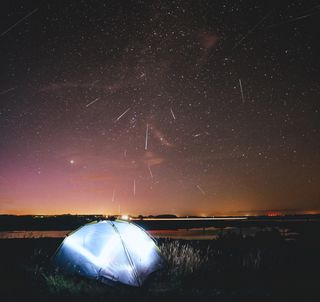
  • 2015 Perseid Meteor Shower within the Danish Sky

    Photo of the 2015 Perseid Meteor Shower within the Danish Sky.

    In our solar system there are billions, possibly trillions, of rogue objects orbiting the sun. These spacefarers are too small to exist called planets and are given the names of comets, asteroids, meteoroids, and if they reach Earth, meteors or meteorites. With so many labels, it's easy to forget which is which.

    Let's start with a brief definition of each.

    Asteroids: These are the rocky and airless leftovers from the formation of planets within our solar system. They mainly orbit our sun within the asteroid belt between Mars and Jupiter and range from the size of cars to dwarf planets.

    Comets: Comets are dirty volume snowballs of mainly ice and grime that formed during the birth of the solar system 4.6 billion years ago. Most comets have stable orbits within the outer reaches of the solar system past the planet Neptune.

    Meteoroids, Meteors, Meteorites: Meteoroids are tiny asteroids or the broken-off crumbs of comets and sometimes planets. They range within size from a grain of sand to boulders 3 feet (1 meter) wide. When meteoroids collide with a planet's atmosphere, they become meteors. If those meteors survive the atmosphere and beat the planet's surface, their leftovers are called meteorites. 

    Related: between 1999 and 2018, from NASA Jet Propulsion Laboratory. 

    Join Our Newsletter

    Back To Top